Encrypted Desktop App
Line by Line
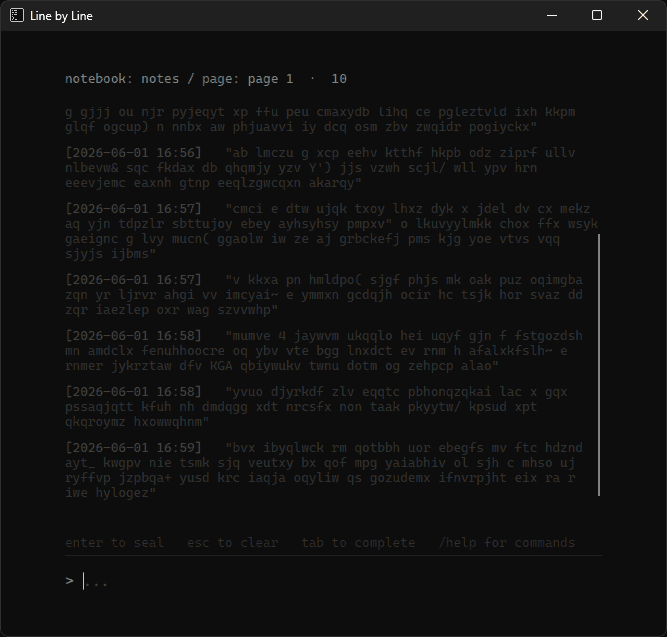
A local-first desktop journal where entries seal on submit and stay encrypted until an unlock date passes, backed by an AES-256-GCM SQLite vault whose key is derived from the passphrase and never stored.
Employer signal
What This Project Shows
This project shows that I can apply cryptography correctly with standard library primitives and ship the result as a real, downloadable cross-platform desktop app with its own CI/CD pipeline.
Problem
What Needed To Be Solved
Most journaling apps show your words the moment you open them, which invites re-editing and rumination, and many also sync everything to a server. The goal was a tool built around delayed reflection that stays genuinely private: no account, no sync, no server, and no way to immediately reread what you just wrote.
Approach
How I Built The Solution
Each entry is encrypted the instant you press Enter and locked until a configurable unlock date. The vault key is derived fresh from the passphrase on every unlock via PBKDF2 and zeroed from memory on lock, so nothing sensitive is persisted. A deterministic 'sealed preview' scramble shows the shape of locked writing without leaking any content.
Outcome
What It Demonstrates
Line by Line demonstrates end-to-end product ownership: a privacy-focused desktop app with correct authenticated encryption, a responsive native UI under crypto load, and a build-verify-package-distribute pipeline that produces downloadable binaries from a single git tag.
Evidence From Source
Source signal
The vault encrypts a known `LINE_BY_LINE_CHECK_V1` token to verify the passphrase, stores `ciphertext ++ 16-byte tag` per entry with the nonce in a separate column, and calls `Array.Clear` on the key bytes on Ctrl+L, Ctrl+W, `/lock`, and window close.
Engineering decision
The README honestly notes that unlock timing is app-enforced, not cryptographic: the app prevents casual access, not an adversary with direct DB access and the passphrase. Naming the threat model accurately is part of doing security work credibly.